
Kingdom
Pseudomonadati
Phylum
Myxococcota
Class
Myxococcia
Order
Myxococcales
Family
Myxococcaceae
Genus
Myxococcus
Description
Taxonomy
| Kingdom | Pseudomonadati |
|---|---|
| Phylum | Myxococcota |
| Class | Myxococcia |
| Order | Myxococcales |
| Family | Myxococcaceae |
| Genus | Myxococcus |
| Species | Myxococcus fulvus |
| Strain | No strain |
Profile
| Physiology | |
|---|---|
| Gram staining properties | Negative |
| Shape | Cocci |
| Mobility | Not Available |
| Flagellar presence | Yes |
| Number of membranes | Not Available |
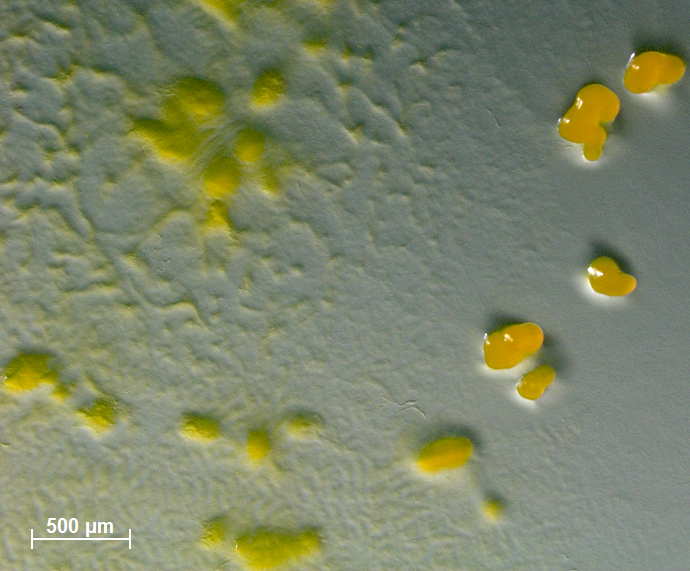
Image source: Wikipedia/Wikimedia
| Ecology, Host, and Life Cycle | |
|---|---|
| Oxygen requirements | Not Available |
| Optimal temperature | Not Available |
| Temperature range | Not Available |
| Habitat | compost |
| Biotic relationship | Not Available |
| Host(s) | Not Available |
| Cell arrangement | Not Available |
| Sporulation | Not Available |
| Energy source | Not Available |
| Pathogenicity | Not Available |
Gene Summary
Adenine Count
1615502 bp
Thymine Count
1631698 bp
Guanine Count
3810250 bp
Cytosine Count
3766219 bp
Genome Length
10824667 bp
Protein-coding Genes
8574 genes
Non-Coding Genes
79 genes
# of Chromosomes/Plasmids
1
Genes
| Name | Locus Tag | UniProt ID | Strand Orientation | Gene Start/End | Protein Molecular Weight |
|---|---|---|---|---|---|
| predicted dehydrogenase | SAMN05443572_104447 | Not Available | Positive | 4582351 - 4583346 | 35413.3 |
| hypothetical protein | SAMN05443572_104448 | Not Available | Positive | 4583389 - 4584150 | 27472.7 |
| aaa+-type atpase, spovk/ycf46/vps4 family | SAMN05443572_104449 | Not Available | Positive | 4584240 - 4585808 | 57868.8 |
| hypothetical protein | SAMN05443572_104450 | Not Available | Positive | 4585805 - 4586518 | 27039.4 |
| hypothetical protein | SAMN05443572_104451 | Not Available | Negative | 4586680 - 4588020 | 45336.4 |
| hypothetical protein | SAMN05443572_104452 | Not Available | Negative | 4588117 - 4589289 | 41671.7 |
| hypothetical protein | SAMN05443572_104453 | Not Available | Negative | 4589295 - 4590047 | 26351.2 |
| chemotaxis protein chec | SAMN05443572_104454 | Not Available | Negative | 4590072 - 4590671 | 20235.6 |
| two-component system, chemotaxis family, sensor kinase chea | SAMN05443572_104455 | Not Available | Negative | 4590668 - 4593454 | 92233.1 |
| two-component system, chemotaxis family, response regulator chey | SAMN05443572_104456 | Not Available | Negative | 4593504 - 4593878 | 13277.4 |
Pathways
0 pathways
No pathways found
No metabolic pathways have been associated with this bacterium yet.
Health Effects
No health effects information available for this bacterium.
